When a number changes, it is often useful to know how large that change is compared with where it started. A price can go up, a sale can bring a price down, or website traffic can increase or decrease from one month to another.
This is where percentage increase and percentage decrease become useful. Both calculations compare a change with an original value, but one describes growth while the other describes a reduction.
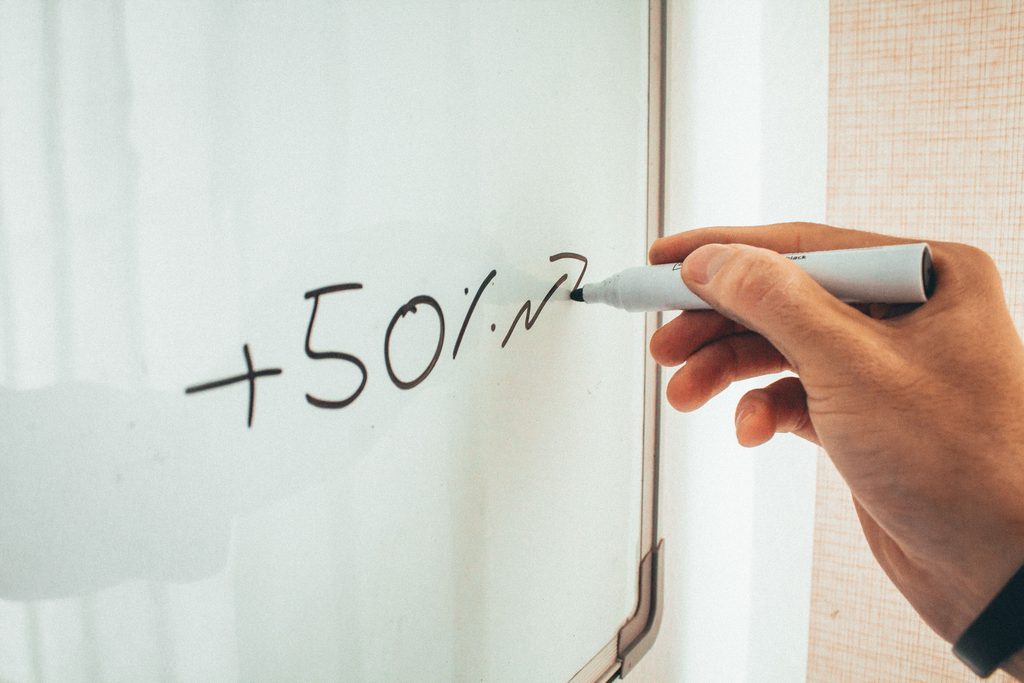
What Is the Difference Between Percentage Increase and Decrease?
The easiest way to tell them apart is to compare the starting value with the new value.
- Percentage increase means the new value is higher than the original value.
- Percentage decrease means the new value is lower than the original value.
In both cases, the original value is normally used as the reference point.
What Is Percentage Increase?
A percentage increase shows how much a value has grown compared with its starting amount.
For example, imagine a product costs $80 and its price later becomes $100. The difference is $20.
First find the increase:
$100 − $80 = $20
Then compare that increase with the original $80:
($20 ÷ $80) × 100 = 25%
The price therefore increased by 25%.
What Is Percentage Decrease?
A percentage decrease works in the opposite direction. It tells you how much a value has fallen compared with where it started.
Suppose an item originally costs $80 but is reduced to $60.
The amount of the decrease is:
$80 − $60 = $20
Now compare the $20 reduction with the original $80:
($20 ÷ $80) × 100 = 25%
So, the price decreased by 25%.
Percentage Increase vs. Decrease: Quick Comparison
| Calculation | What happens? | Example |
|---|---|---|
| Percentage increase | The value becomes larger | $80 to $100 |
| Percentage decrease | The value becomes smaller | $80 to $60 |
The key is to identify whether the new value is above or below the original value.
How to Calculate Percentage Increase
When a number becomes larger, you can use three basic steps:
- Subtract the original value from the new value.
- Divide the difference by the original value.
- Multiply the result by 100.
Example: Salary Increase
Suppose someone’s monthly salary changes from $2,000 to $2,400.
First, find the difference:
$2,400 − $2,000 = $400
Next:
$400 ÷ $2,000 = 0.20
Finally:
0.20 × 100 = 20%
The salary increased by 20%.
How to Calculate Percentage Decrease
When the new value is smaller, the process is almost the same.
- Subtract the new value from the original value.
- Divide the difference by the original value.
- Multiply by 100.
Example: Sales Decrease
Imagine a business records $10,000 in sales during one month and $8,000 during the next.
The decrease is:
$10,000 − $8,000 = $2,000
Then:
$2,000 ÷ $10,000 = 0.20
And:
0.20 × 100 = 20%
The business experienced a 20% decrease in sales.
Why Does the Original Value Matter?
The original value provides the starting point for the comparison. This is why using the correct starting number is important.
Suppose a price rises from $50 to $75.
The increase is:
$75 − $50 = $25
Now calculate the percentage:
($25 ÷ $50) × 100 = 50%
The price increased by 50%.
If you used $75 instead of $50 as the denominator, you would get a different number. That would not describe the increase relative to the original price.
Can the Same Amount Represent Different Percentages?
Yes. A fixed dollar amount can represent very different percentages depending on the starting value.
For example:
- A $20 increase from $100 is 20%.
- A $20 increase from $200 is 10%.
- A $20 increase from $50 is 40%.
This is why it is important to identify the original amount before working out a percentage change.
Percentage Increase Example With Website Traffic
Percentage changes are also useful for website statistics.
Suppose a website receives 5,000 visitors in one month and 6,000 visitors the following month.
The increase is:
6,000 − 5,000 = 1,000 visitors
Now compare that increase with the original 5,000 visitors:
(1,000 ÷ 5,000) × 100 = 20%
Website traffic therefore increased by 20%.
Percentage Decrease Example With Website Traffic
Now imagine the website receives 5,000 visitors one month and only 4,000 the next.
The decrease is:
5,000 − 4,000 = 1,000 visitors
Then:
(1,000 ÷ 5,000) × 100 = 20%
The website experienced a 20% decrease in traffic.
How Discounts Relate to Percentage Decrease
A discount is a familiar example of a percentage decrease because the original price is reduced.
For example, suppose a product costs $100 and receives a 20% discount.
The amount saved is:
$100 × 0.20 = $20
The new price is therefore:
$100 − $20 = $80
If you want to explore this type of calculation further, see our guide on how to calculate a discount.
Percentage Increase and Decrease Are Not Always Reversible
It is easy to assume that increasing a value by a certain percentage and then decreasing it by the same percentage will return you to the starting point. Usually, that is not the case.
For example, start with $100 and increase it by 20%:
$100 + $20 = $120
Now decrease $120 by 20%:
$120 × 0.20 = $24
After the decrease:
$120 − $24 = $96
You end up with $96 instead of the original $100.
The reason is that the second 20% is calculated from $120 rather than $100.
Percentage Points vs. Percentage Change
Percentage points and percentage change describe different things.
Suppose a rate moves from 20% to 25%.
The difference is:
25% − 20% = 5 percentage points
But the relative increase is:
(5 ÷ 20) × 100 = 25%
So the rate increased by 5 percentage points, which is a 25% relative increase.
Percentage Increase and Decrease in Everyday Situations
Percentage change can be useful in many areas of everyday life.
Shopping
Percentage decrease can help you understand discounts and price reductions.
Salary
Percentage increase can show how much a new salary has changed compared with the previous one.
Business
Businesses can compare sales, revenue, expenses, and customer numbers over different periods.
Website Analytics
Website owners can use percentage changes to compare visitors, conversions, and other statistics.
Exam Results
Students can compare scores from different tests to see whether their results have improved or fallen.
Percentage Change vs. Percentage Difference
Percentage change and percentage difference are not exactly the same calculation.
Percentage change normally has a clear starting value, while percentage difference is generally used when comparing two values without treating either one as the starting point.
For a separate explanation, you can read our guide to percentage difference.
Quick Formulas
Percentage increase:
(New Value − Original Value) ÷ Original Value × 100
Percentage decrease:
(Original Value − New Value) ÷ Original Value × 100
Increase amount:
New Value − Original Value
Decrease amount:
Original Value − New Value
Using a Percentage Calculator
If you need to perform several percentage calculations, an online calculator can save time and reduce the amount of manual arithmetic.
The ToolRava Percentage Calculator can be used for common percentage calculations.
You can also read our guide on how to calculate percentages for additional examples and explanations.
Frequently Asked Questions
What is the difference between percentage increase and percentage decrease?
Percentage increase describes how much a value has grown compared with its original amount. Percentage decrease describes how much it has fallen from that starting amount.
What formula is used for percentage increase?
Subtract the original value from the new value, divide the difference by the original value, and multiply by 100.
What formula is used for percentage decrease?
Subtract the new value from the original value, divide the difference by the original value, and multiply by 100.
Why do I use the original value?
The original value represents the starting point of the comparison. Using it as the reference gives you the percentage change relative to where the value began.
Can an increase and decrease of the same percentage cancel each other out?
No. Applying the same percentage increase and decrease usually does not return a value to its starting point because the second calculation is based on a different amount.
Final Thoughts
Understanding percentage increase and decrease makes it easier to describe changes in prices, salaries, sales, website traffic, test results, and many other situations.
The most important step is identifying the original value. Once you know whether the new amount is higher or lower, the appropriate formula becomes straightforward.
For quick calculations, an online Percentage Calculator can also help you check your result.